
Commercial doors are the backbone of daily operations because they keep vehicles, freight, and staff moving in and out without friction throughout the day. Built from durable materials to handle demanding environments, these overhead systems are designed for constant use so you can rely on them to perform smoothly even under pressure. That kind of dependability becomes part of the routine, especially when the door is cycled over and over as work moves forward.
Everything changes when it stops without warning, because a sudden failure doesn’t just slow you down but can throw the entire shift into disorder, even when the commercial garage door installation seemed solid at the start. For businesses in Vallejo, CA, a broken commercial garage door can interrupt schedules, create security gaps, and strain workflows at the worst possible moment. In this article, we’ll walk through the high-stakes situations that unfold when a door fails mid-operation, and why getting qualified help quickly matters when continuity is on the line.
The Fallout of Sudden Commercial Garage Door Failures in Vallejo, CA
When service doors stop working without warning, downtime shows up immediately because shipments stall, workflows freeze, and people are left waiting for access. What should be routine movement through the building turns into a bottleneck that slows the entire operation, especially in Vallejo, CA, where many businesses rely on steady loading and unloading cycles to meet daily demands. Missed deadlines, frustrated clients, and stressed staff tend to follow fast, with the disruption landing not only on schedules but also on the resources it takes to recover momentum once the door finally moves again.
The situation grows more complicated when the failure demands specialized attention, since not every crew is equipped to diagnose commercial systems quickly or restore them the right way on the first visit. For business owners, the challenge isn’t just getting the door running again, but doing so with minimal delay and without repeating the same breakdown a week later. That’s why a sudden failure feels larger than the mechanical issue itself: it forces operations to pause while the right response is identified.
For a deeper look at these high-pressure breakdown moments, read “What Happens When Commercial Garage Doors Fail at the Worst Possible Time?”
Business Disruption That Signals Commercial Garage Door Repair Needs
One of the clearest signs of trouble is when an overhead door refuses to open or close, because vehicles get trapped inside, deliveries can’t be staged, and staff lose a critical access point. Whether the cause is electrical, mechanical, or tied to the door’s control system, the effect is the same once movement stops, with order fulfillment thrown off and the supply chain taking a hit that partners and customers notice right away.
Another costly scenario appears when the door slips out of its tracks, since a misaligned system isn’t only immobile but also unstable. Commercial doors carry serious weight, so a track failure can create an immediate hazard for people and property in the area, while also turning what might have been a straightforward interruption into a larger operational shutdown. In those moments, the disruption isn’t limited to the bay where the door sits, because safety concerns and blocked access ripple outward through the rest of the shift.
Unplanned Shutdown Moments That Expose Gaps in Commercial Garage Door Service
A commercial garage door that fails mid-operation doesn’t just stop the day; it reveals weak points in how the site is prepared for equipment breakdowns. If the response begins with a scramble to find help or figure out what the door needs, it becomes clear that the operation is reacting rather than ready, which often stretches downtime longer than anyone expects. The pressure rises because every stalled minute compounds into scheduling conflicts, security exposure, and staff frustration, all of which make the failure feel chaotic instead of contained.
These surprise breakdowns also highlight patterns that tend to sit unnoticed until a door quits at the worst time, such as:
- No established relationship with a dependable commercial garage door repair team
- Limited awareness of the door system’s specific demands and weak points
- No clear path forward when repair is no longer enough, and replacement becomes necessary
When a sectional garage door stops out of the blue, it isn’t only a mechanical event but a stress test for the whole operation, because it shows how quickly normal work can unravel when one critical entry point goes silent.
Primary Failure Triggers in Commercial Garage Door Systems
Commercial garage doors take a beating in busy facilities because they’re opened and closed repeatedly across every shift, sometimes hitting hundreds of cycles in a single day. That level of constant motion places far more strain on components than residential doors ever do, which is why wear shows up sooner, and failures tend to feel sudden when a part finally reaches its limit. What starts as routine daily use can turn into a system-wide stoppage when a key element slips out of spec, because every moving piece depends on the next to carry the load.
Each component has a specific role within the larger system, so when the motor, springs, rollers, or control hardware begins to weaken, the door doesn’t just run poorly but can stop entirely under pressure. Understanding the most common triggers behind these breakdowns helps you recognize why commercial garage doors fail so abruptly, even if the door seemed fine the day before. Below, we’ll unpack the two main categories behind most failures, looking first at heavy-use mechanical strain and then at the control and safety systems that quietly determine whether the door responds when it matters most.
For more on how this plays out in real time, check out “When Commercial Garage Doors Stop Mid-Shift: What Businesses Usually Face Next.”
Heavy-Use Strain That Shortens Commercial Garage Door Opener Reliability
The commercial garage door opener sits at the center of automated operation, which means its motor and internal drive parts are in near-constant motion in high-traffic environments. Over time, that nonstop workload creates gradual wear that may not be obvious until the opener begins to hesitate, sound rough, or fail to respond on command, since the system can only compensate for so long before performance drops sharply. When an opener starts acting irregularly, it’s often the early stage of a larger breakdown, because the door is asking the motor to do more work than it was designed to carry once internal parts begin to fatigue.
Mechanical stress also builds across the rest of the door assembly, especially in torsion springs, rollers, and hinges that cycle under full load with every open and close. Springs are engineered for a finite cycle range, so each lift brings them closer to failure, and when one finally snaps, the door usually stops on the spot with a suddenness that catches everyone off guard. Rollers and hinges wear in quieter ways, but their degradation can still destabilize door travel and increase resistance, which forces the opener to work harder and shortens its lifespan faster than expected. Because these parts operate as a single chain, one weakened link accelerates strain across the rest of the system, which is why squeaks, jerky travel, or uneven movement often show up right before a more serious stoppage.
Control and Safety System Breakdowns Affecting Commercial Garage Door Installation Performance
Even when the mechanical side is strong, the real-world performance of a commercial garage door installation depends on control and safety systems that decide how and when the door moves. When those electronic elements fail, the impact can be just as disruptive as a broken spring, since a door may refuse to close, stop mid-track, or become completely unresponsive without any visible mechanical damage. Sensors, wiring, and logic hardware work quietly in the background, so problems there can feel mysterious at first, especially when the door looks intact but won’t behave normally.
Electrical failures can still surface after routine service when an underlying defect goes unnoticed or when environmental stress affects sensitive components, which is why professional diagnosis matters once the door behaves inconsistently. A control board issue, for example, can imitate a mechanical problem, and a compromised sensor can make a healthy door appear unsafe to operate, causing sudden shutdowns even though the hardware is still physically capable of moving. To make the common failure points clearer, here’s how the major system components tend to break down in commercial settings:
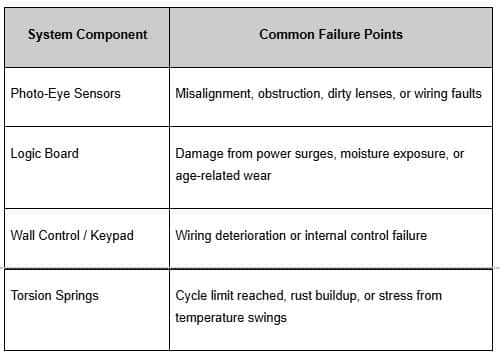
Understanding how each component connects to a specific type of failure makes sudden breakdowns easier to interpret when they happen, whether you’re dealing with rolling doors and grilles or other commercial systems, because the symptom you see is often the end result of stress building quietly over time.
What Happens Mid-Shift When Commercial Garage Doors Fail Without Warning
A mid-shift failure with an overhead door can bring business to a standstill in seconds, because everything looks normal right up until the moment the door jolts, grinds, or refuses to move. What follows isn’t a minor inconvenience but an immediate operational block, with your main access point suddenly unusable and the flow of vehicles, shipments, and people cut off at the busiest part of the day. When a commercial garage door won’t open or close, the priority shifts to keeping the area controlled and letting a qualified professional handle the door, since forcing movement on a stalled system can turn a delay into a safety issue.
For business owners, this is the moment where pressure spikes, because a door that usually fades into the background becomes the single point of failure everyone is waiting on. Every minute the door stays down stretches schedules and strains resources, which is why these breakdowns feel so disruptive when they happen mid-shift. The real impact isn’t just the stalled door but the chain reaction that comes after, especially when the operation has to make rapid decisions to protect workflow and security while the fix is underway.
Want the bigger operational picture? Read “The Hidden Stress Commercial Garage Doors Failures Put on Daily Operations.”
Operational Delays That Trigger Immediate Commercial Garage Door Repair
Once a commercial garage door fails, delays start stacking up instantly, because trucks can’t roll out, inbound shipments can’t be staged, and dock activity begins to choke on itself. A single stuck door can derail delivery routes and compress the rest of the schedule into a smaller window, which pushes packing, shipping, and receiving into a bottleneck that affects the entire facility. As the loading area fills and inventory timing slips, the disruption spreads beyond the dock, since downstream teams can’t move product that hasn’t arrived or leave with what hasn’t cleared the bay.
That’s why mid-shift failures create urgency around commercial garage door repair, because restoring movement quickly is the only way to stop the slowdown from turning into a full-day loss. In Vallejo, CA, businesses depend on repair crews who understand how commercial systems behave under load and can pinpoint the fault without guesswork, since time is already leaking out of the operation by the minute. When the door is back online, the goal isn’t just to get it moving again but to stabilize the day before delays harden into missed commitments.
The stakes rise even more when a sheet door can’t secure at closing time, because an opening that won’t shut leaves the facility exposed when staff are ready to head out. What feels like a mechanical problem during the shift can become a security liability after hours, which is why these breakdowns demand immediate, professional attention. The fastest path back to control is a repair response that resolves the failure efficiently and restores the door to safe, reliable operation, so the rest of the day can recover its footing.
Chain-Reaction Slowdowns That Test Commercial Garage Door Service Response
When a garage door fails, the disruption spreads fast across the entire business because a single stuck entry point can slow movement everywhere, leaving some employees unable to access work areas while workflows unravel and product flow stalls. What should be a routine part of the day suddenly becomes a pressure test for how quickly outside support can restore normal operations, since the longer the door stays down, the more delays multiply through production, shipping, and customer-facing teams. Production can pause when materials can’t reach the floor, shipping schedules slip when trucks miss pickup windows, staff time is wasted as people wait for access to reopen, and customer service gets pulled into explaining late orders, which is why rapid professional repair matters not just to fix one door but to keep the whole operation from sliding off track.
When commercial garage doors stop working without warning, businesses feel the impact immediately because even a brief failure can slow operations, disrupt schedules, and create avoidable stress across the floor. Being familiar with the usual causes and the fallout they trigger makes a real difference, since preparation gives you the ability to respond with clarity instead of scrambling under pressure. The more aware a team is of the risks tied to unreliable doors, the easier it becomes to protect workflow and maintain momentum, especially when regular professional attention is already part of the routine. And when a breakdown does happen, having dependable support ready to step in helps you restore normal operations faster, which matters most when every minute of uptime counts.
If you’re looking for a team that understands how commercial door failures disrupt real operations, R&S Erection of Vallejo is built for that reality, with crews who know what it takes to get businesses moving again when doors fail at the worst possible time. We focus on commercial systems, handle high-traffic facilities, and respond with the urgency your workflow demands. Contact us today to get the support your operation needs. Call now and keep your business running without missing a beat.
Frequently Asked Questions
Can emergency commercial garage door repair handle every type of door and operating setup?
Emergency commercial garage door repair can handle most standard door types and operating setups, including sectional, rolling steel, and high-cycle systems, because experienced crews arrive prepared for the failures that happen most often. If a door is highly specialized or custom, the team can usually secure it and restore safe function first, then follow up once any uncommon parts are sourced.
Why do commercial garage doors sometimes fail even after routine commercial garage door service?
Failures can still happen after routine commercial garage door service because some issues develop between visits or originate outside the visible wear points, such as sudden electrical faults or environmental stress that accelerates corrosion. Even a well-maintained system can break when a hidden weakness reaches its limit under daily load.
What are commercial garage doors, and how are they built differently from residential doors?
Commercial garage doors are heavy-duty access systems built for frequent cycles and wider openings with stronger materials, reinforced tracks, and high-capacity openers so they can withstand constant industrial use, as field guidance from CCPIA shows when evaluating commercial exterior door performance. Engineered for durability and security in demanding environments, they rely on construction and hardware that go far beyond what residential doors typically require.
What are the most common problems that cause commercial garage doors to fail without warning?
Sudden failures most often come from critical components giving out under stress, especially torsion springs that hit their cycle limit, tracks that shift or deform, and openers that stop responding due to mechanical or control issues. When one of these core elements fails, the whole door can shut down instantly.
Which forms of commercial garage doors are usually maintainable through repair rather than total replacement?
Most commercial garage doors can be restored through commercial garage door repair when the issue is isolated to parts like springs, cables, rollers, or panels, because the core structure still holds safely. Replacement becomes the more practical route when damage is extensive, corrosion is widespread, or the system is too worn to support reliable operation.
What does it mean when a commercial garage door opener starts running inconsistently?
Inconsistent opener behavior usually signals an underlying electrical, sensor, or control problem, since uneven power delivery, faulty wiring, misreading safety inputs, or a weakening control board can cause stop-start motion or delayed response. When the operation becomes unpredictable, it often means the opener is losing stability under load.
What operational risks follow when commercial garage doors won’t open or close during business hours?
When commercial garage doors won’t open or close during business hours, operations can stall immediately because vehicles, shipments, and staff movement are blocked, creating delays that spread across receiving, dispatch, and production. Security risks rise as well, especially if a door is stuck open or cannot secure the facility at shift end.
Are after-hours commercial garage door repair options available in Vallejo, CA, for urgent failures?
After-hours commercial garage door repair is widely available in Vallejo, CA, because many providers support urgent callouts when a breakdown threatens operations or security outside normal work windows, with safety expectations for powered door systems reinforced by standards shared through UL Standards & Engagement. These services are built for rapid response when doors fail at the worst possible time.
How can issues tied to commercial garage door installation lead to parts loosening over time in busy facilities?
Installation issues can lead to parts loosening over time because misaligned tracks, uneven mounting, or poorly seated fasteners create vibration and uneven force with every cycle. In busy facilities where doors run constantly, those small stresses compound quickly until hardware shifts and wear accelerates.
Can emergency commercial garage door repair handle every type of door and operating setup?
Emergency commercial garage door repair can handle most standard door types and operating setups, including sectional, rolling steel, and high-cycle systems, because experienced crews arrive prepared for the failures that happen most often. If a door is highly specialized or custom, the team can usually secure it and restore safe function first, then follow up once any uncommon parts are sourced.
Why do commercial garage doors sometimes fail even after routine commercial garage door service?
Failures can still happen after routine commercial garage door service because some issues develop between visits or originate outside the visible wear points, such as sudden electrical faults or environmental stress that accelerates corrosion. Even a well-maintained system can break when a hidden weakness reaches its limit under daily load.
What are commercial garage doors, and how are they built differently from residential doors?
Commercial garage doors are heavy-duty access systems built for frequent cycles and wider openings with stronger materials, reinforced tracks, and high-capacity openers so they can withstand constant industrial use, as field guidance from CCPIA shows when evaluating commercial exterior door performance. Engineered for durability and security in demanding environments, they rely on construction and hardware that go far beyond what residential doors typically require.
What are the most common problems that cause commercial garage doors to fail without warning?
Sudden failures most often come from critical components giving out under stress, especially torsion springs that hit their cycle limit, tracks that shift or deform, and openers that stop responding due to mechanical or control issues. When one of these core elements fails, the whole door can shut down instantly.
Which forms of commercial garage doors are usually maintainable through repair rather than total replacement?
Most commercial garage doors can be restored through commercial garage door repair when the issue is isolated to parts like springs, cables, rollers, or panels, because the core structure still holds safely. Replacement becomes the more practical route when damage is extensive, corrosion is widespread, or the system is too worn to support reliable operation.
What does it mean when a commercial garage door opener starts running inconsistently?
Inconsistent opener behavior usually signals an underlying electrical, sensor, or control problem, since uneven power delivery, faulty wiring, misreading safety inputs, or a weakening control board can cause stop-start motion or delayed response. When the operation becomes unpredictable, it often means the opener is losing stability under load.
What operational risks follow when commercial garage doors won’t open or close during business hours?
When commercial garage doors won’t open or close during business hours, operations can stall immediately because vehicles, shipments, and staff movement are blocked, creating delays that spread across receiving, dispatch, and production. Security risks rise as well, especially if a door is stuck open or cannot secure the facility at shift end.
Are after-hours commercial garage door repair options available in Vallejo, CA, for urgent failures?
After-hours commercial garage door repair is widely available in Vallejo, CA, because many providers support urgent callouts when a breakdown threatens operations or security outside normal work windows, with safety expectations for powered door systems reinforced by standards shared through UL Standards & Engagement. These services are built for rapid response when doors fail at the worst possible time.
How can issues tied to commercial garage door installation lead to parts loosening over time in busy facilities?
Installation issues can lead to parts loosening over time because misaligned tracks, uneven mounting, or poorly seated fasteners create vibration and uneven force with every cycle. In busy facilities where doors run constantly, those small stresses compound quickly until hardware shifts and wear accelerates.