

A noisy garage door almost always starts at the rollers, and the sound itself usually offers a clue about what’s wrong. Squealing, grinding, popping, and a low rumble can each point to a different cause, from a dry bearing to a bent track to a roller that’s nearing failure. Most of these fixes are inexpensive and take only a few minutes, but a roller that’s jumped the track or cracked at the stem can damage the track or the door panel if it’s left alone, turning a simple fix into a full garage door roller repair.
This guide breaks down five common causes, what each sound may be telling you, and what to check before deciding between a quick lubrication job and a roller replacement.
Key Takeaways
- Squealing often means dry or worn rollers, rather than a motor problem.
- Grinding or grating can point to a bent track or a roller coming apart internally.
- Popping or banging is often a roller riding out of alignment in the track.
- Nylon rollers tend to run quieter than steel by design, though the better material overall still depends on the door, usage, and priorities like durability or load capacity.
- A roller that wobbles, cracks, or leaves metal shavings in the track generally needs replacing rather than lubricating, since lubrication typically won’t fix a roller that’s already past the point of a garage door roller replacement.
- Left alone, a bad roller can wear the track faster and pull the door off-balance.
Lubricate vs. Replace: A Quick Comparison
Before working through each cause in detail, use this table as a general starting point for whether your sound calls for lubrication or replacement. Individual situations can vary, so use this alongside a visual check.
| Situation | Lubricate | Replace |
| New squeal, rollers roughly under 2-3 years old | Yes | Not yet |
| Squeal returns within days of lubricating | No | Yes |
| Grinding, grating, or visible cracks | No | Yes |
| Roller wobbles on the stem | No | Yes |
| Popping near the same track spot repeatedly | Check track alignment first | Yes, if roller has jumped track |
| Metal shavings visible in track | No | Yes |
The Door Squeals Every Time It Moves
A high-pitched squeal on every cycle is often a lubrication issue rather than roller failure. Steel bearings can dry out over time, especially with dust, temperature swings, or coastal humidity, and metal-on-metal contact inside the housing is typically what you’re hearing.
The fix here is usually simple and doesn’t require any parts:
- Wipe down the tracks and rollers to clear built-up dust and old lubricant residue before applying anything new.
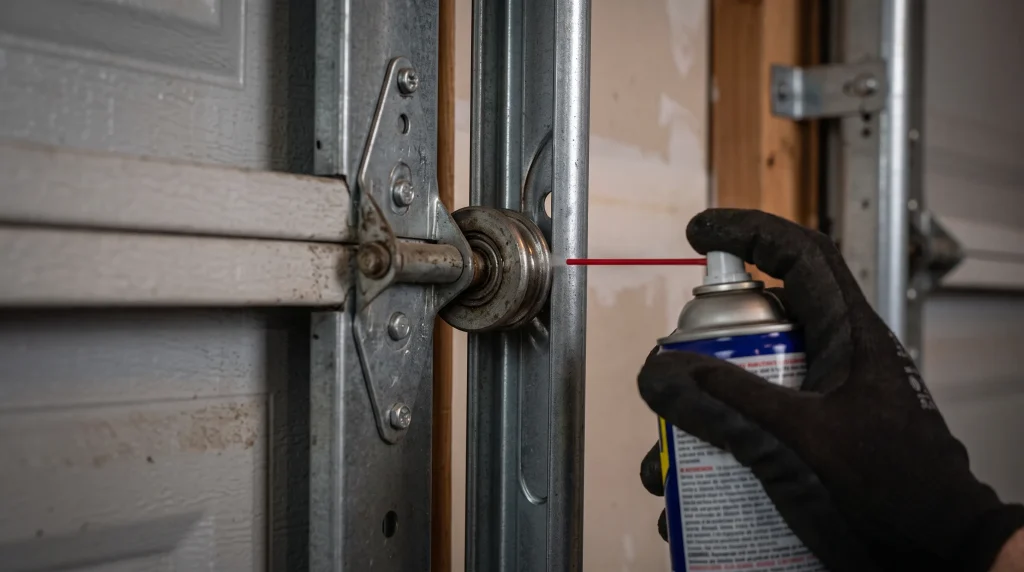
- Apply a silicone-based garage door lubricant directly to the roller bearings and hinges, not WD-40, which attracts dust and evaporates too quickly to help long-term.
- Run the door through 3 to 4 full cycles to work the lubricant into the bearings evenly.
How to Fix a Squealing Garage Door Roller
If the squeal returns within a week or two of lubricating, the bearing itself is likely worn out rather than simply dry, and it’s generally worth replacing the roller rather than lubricating it again.
The Door Grinds or Grates as It Opens
A grinding or grating sound usually signals metal-on-metal contact that lubrication alone won’t fix. Most often, this traces back to one of two things:
- A roller with a damaged or missing internal bearing, letting the metal wheel grind directly against its own housing instead of spinning smoothly.
- A track that’s bent enough to bind against the edge of the roller instead of letting it roll freely through the curve or straight section.
Check the roller wheel by hand for flat spots, cracks, or looseness on the stem, and run a straightedge along the track for inward or outward bends near hinges. Metal shavings or fine dust in the track can be a strong sign the bearing has already started breaking down.
Why a Bent Track Causes Garage Door Roller Grinding
A bent track forces the roller to fight the rail on every pass, which can wear out even a brand-new roller within weeks. If the grinding traces back to the track rather than the roller, the track generally needs straightening or replacing before a new roller goes in, otherwise, the replacement can wear out the same way.
The Door Pops or Bangs While Moving
A popping or banging sound that repeats near the same spot on the track usually means a roller has partially jumped the track and is catching on a hinge, bracket, or seam. This is the most urgent pattern on this list, since a fully derailed roller can cause the door to bind or drop unexpectedly.
- Watch the rollers through a full open-close cycle to see exactly where the pop happens.
- Check that the track brackets are still tightened and haven’t shifted away from the wall.
- Confirm the roller stem is fully seated in the hinge bracket rather than sitting at an angle.
According to DASMA’s safety guidance for homeowners, a garage door that’s binding, jumping track, or making unusual noise during operation should be taken out of automatic use until it’s inspected, since a partially derailed roller can lead to a sudden door drop under load.
What a Popping Sound Near the Track Curve Usually Means
If the popping happens specifically where the track curves from vertical to horizontal, the roller is likely catching on the curved section itself, which sits closer to the spring system and is best left to a professional to realign.
If you’re also noticing the door feels stiffer to open by hand around the same time, it’s worth reading our guide on Can You Replace Garage Door Rollers Yourself? 4 Risks to Know First, since a jumped roller near the top of the door sits close enough to the spring system that it changes the safety calculation on any DIY fix.
The Door Feels Heavier to Lift, but Sounds Fine
Sometimes the noise is subtle, more of a low rumble than a sharp squeal or grind, but the door feels harder to lift by hand or the opener seems to strain more than it used to. This pattern can show up when several rollers are worn at once rather than just one, which spreads the extra friction more evenly across the door instead of concentrating it in a single, easy-to-spot location.
- Test-lift the door manually with the garage door opener disconnected to feel for uneven resistance across the full range of motion.
- Inspect every roller along both tracks, not just the ones near eye level, since wear often starts at the top rollers first.
- If more than two or three rollers show wear, it’s usually worth planning to replace the full set rather than one at a time, so wear stays even across the door going forward.
How to Tell If Multiple Rollers Are Wearing at Once
Run your hand along each roller wheel while the door is open. Slight give or a gritty texture on more than two rollers can often mean age-related wear across the set, rather than a single bad part.
For sounds that don’t trace back to the rollers specifically, like opener issues or spring noise, see The Spruce’s guide to common garage door problems. And if you’re wondering whether it’s time to replace the whole set, How Often Should You Replace Garage Door Rollers? 7 Signs It’s Time lays out the full checklist.
The Noise Started Right After a Roller Replacement
If new rollers are already noisy, common causes include the wrong roller size, a stem that isn’t fully seated, or steel installed where nylon was expected.
- Confirm roller stem length matches the hinge bracket depth for that specific door.
- Check that nylon rollers weren’t swapped for steel, or the reverse, without accounting for the noise difference.
- Re-inspect the install after the first week; noise from a fresh install that doesn’t fade usually means a fit issue rather than a break-in period.
If you’re deciding between materials for this exact reason, our comparison on Nylon vs. Steel Garage Door Rollers: Which Lasts Longer? 6 Key Differences walks through how much quieter a nylon upgrade tends to run, and how that trades off against cost, durability, and lifespan.
Why a Fresh Roller Installation Might Still Sound Off
A slight hum for the first few cycles after installation is normal break-in. A grinding or rattling sound that persists past the first week often means the wrong part was used rather than a settling-in period that will resolve on its own.
A Quieter Garage Door Is a Small Fix Away
If you’ve worked through the five patterns above, you likely already have a good sense of whether you’re dealing with a quick lubrication job or a roller that’s earned its retirement. Either way, the fix is usually fast and affordable, and it helps prevent the bigger repair that comes from ignoring it: a bent track, a strained opener motor, or a door that eventually binds mid-cycle.
R&S Erection of Vallejo works with Vallejo homeowners who’d rather have a second opinion before buying parts or attempting a fix. Contact us today or give us a call to talk through scheduling and pricing and get your door running quiet again.
Frequently Asked Questions
Can I use regular oil instead of garage door lubricant?
We don't recommend it. Motor oil and household oils attract dust and grime that can build up on the bearing over time, often making the noise worse within a month. A silicone-based garage door lubricant is generally the safer, longer-lasting choice.
How often should I lubricate garage door rollers?
As general guidance, lubricating roughly twice a year, in spring and fall, works well for many Vallejo homes, though more frequent lubrication may be needed with heavy dust, coastal salt air, or frequent daily use.
Is it normal for new rollers to be a little noisy at first?
A slight break-in hum for the first few cycles is common and usually fades on its own. Persistent grinding past about a week usually points to a fit issue rather than normal break-in.
Can one bad roller cause the whole door to sound off-balance?
Yes. A single worn roller can create uneven resistance that makes the entire door sound like it's straining, even when the rest of the hardware is fine.
How do I know if the noise is coming from the rollers or the opener chain?
Disconnect the opener and move the door by hand through part of a cycle. If the noise is still there, it's the rollers or track. If it disappears, the opener chain is the likelier source.
Will ignoring a noisy roller cause bigger damage?
It can. A grinding or off-track roller can strain the brackets and panel it's attached to, and what starts as a small fix can turn into a full track repair if left too long.
Do nylon rollers really run quieter than steel?
Generally, yes. Nylon tends to run quieter by design because the softer material absorbs vibration that steel transmits more directly into the track. That said, steel can still be the better choice in situations where durability, load capacity, or cost outweighs noise as the priority.
What does it mean if I see metal shavings in the track?
This is generally a sign a steel roller's internal bearing has started breaking down and is grinding against itself, and it's one of the clearer signs a roller needs replacing rather than another round of lubricating.
How much does it typically cost to fix a noisy garage door roller?
Costs vary depending on whether it's a lubrication visit, a single roller swap, or a full-set replacement, generally ranging from an affordable service call to a moderate investment for a complete set. We'll give you a specific quote after a quick inspection.